

“Hopeless.” That’s probably the word that crossed my mind the most when I started trying to climb in League of Legends. The start of my journey felt like my boat was already sinking, and most of my energy went into trying to somehow scoop the water out of my tiny vessel. For every win, I had to face another loss, and every two or three losses felt like I had to play twice as many games just to get back to where I was before.
I knew what I was doing wasn’t working. It didn’t help me climb and, even worse, it made me feel like shit about myself and a hobby I used to be excited about. What had been my favorite activity after finishing work and chores became something draining the moment I started taking it more seriously.
But trying to climb and improve wasn’t what was making me miserable. It was how I tried to climb in League of Legends. The reality is that climbing the ranked ladder in League is anything but intuitive for the average player. Not only because the game is so difficult, but also because of the nature of how improvement in League of Legends works.
That doesn’t mean it’s impossible, though. As someone who climbed from Iron to Emerald by using a consistent, practical climbing plan, I will share the strategy that finally allowed me to improve. Before I start, though, I want you to know two things about me: First, I am 32 years old and an adult with a busy schedule. Second, I had never played a competitive multiplayer game before, especially not a MOBA like LoL. Therefore, I can assure you that the practical climbing methods I share with you will work even with limited time available and, maybe even more importantly, you don’t need any talent or prior experience to succeed with them.
Don’t chase the rank, play at that rank’s level
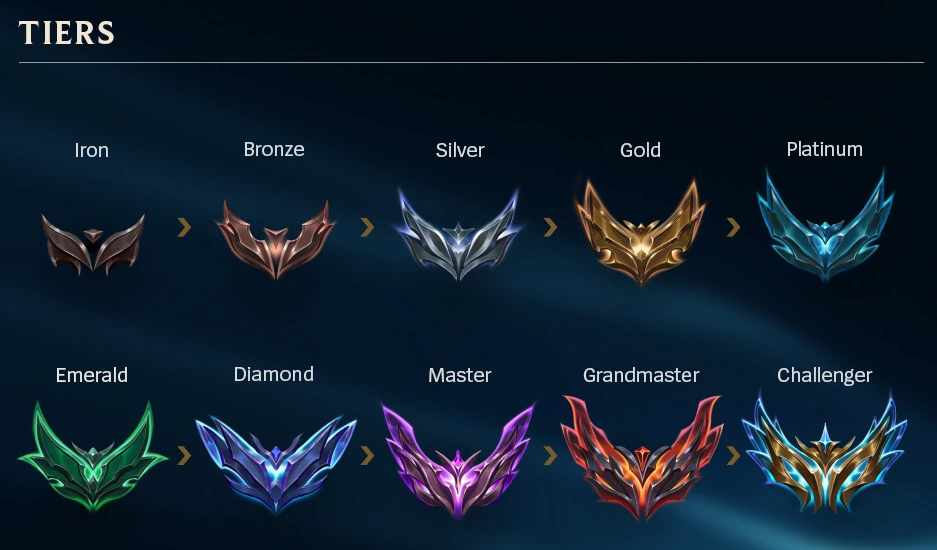
Let’s start with what drives most of us to queue up every day: rank goals. No matter whether you want to be Gold or Emerald or even Challenger one day, you probably focus a lot of your mental energy on that goal. You imagine yourself at that rank, you consult guides on how to get there, and, naturally, you get angry and frustrated when you feel like something is pushing you away from that goal, be it a series of rough games, bad teammates, bad matchups, or out-of-game constraints like limited playtime.
The key piece of advice that changed my whole perception of this was simple but powerful: Aim to be a player of the rank, not the rank. That might sound redundant, but bear with me. There is a very important difference between the two. While one focuses on the outcome alone (“I want to be Emerald”), the other focuses on the skills you need to develop to get there (“I want to have the skills of an Emerald player”).
Now, while Emerald as a concept is really hard to grasp (“What does an Emerald player do in general?”), the skills themselves at an Emerald level can be broken down and analyzed. Instead of just trying to “get better” or to “rank up,” which is very vague, you can give yourself actionable goals that will slowly transform you as a player, one by one, until you reach an Emerald level with your gameplay.
Get specific: What do higher-Elo players actually do better?
For example, let’s say you play an immobile ADC like Jinx and have a lot of deaths while being in Gold. You might realize that Emerald Jinx players die a lot less on average. So you might conclude that you “just need to die less” to get to Emerald, which is already the first step. But in order to turn this into an actionable step towards Emerald that you can actually work with, you need to get even more specific.
You can tackle this problem from two angles: First, look at your own gameplay and, most importantly, your deaths. Put on your detective hat and take notes on why you die. Were you out of position? Were you chasing a kill? Did you overestimate your damage or underestimate the enemy’s? Did you simply misclick? Second, compare your own findings with the gameplay of an Emerald Jinx and look for small differences.
Why is she scared to walk up in this fight? When does she play aggressively? And so on. You will quickly notice differences and, more importantly, patterns that you can address in your own gameplay. This way, “I need to die less” will slowly turn into actionable learning objectives like “I need to be mindful of my jungler’s location when I play aggressively in lane,” tailored to your own gameplay shortcomings that currently keep you at your rank.
How chasing short-term LP stops your long-term climb
Breaking down and improving those skills is only half of the battle, though. The other half is consistency. League of Legends is a game that gives us a lot of options to choose from. You can pick a role, a champion, a build, and even a specific strategy or playstyle within that. You may even play multiple roles or champions, trying to have an answer for every game and situation.
That might even work in the short term. We all know how satisfying certain counter picks can feel, for example when the enemy chooses Malphite and we lock in Sylas to steal the powerful ultimate. We might win that game, but since we are not a Sylas player and won’t experience what it’s like to play the champion in difficult games, we won’t really learn or improve much from it.
In order to gain LP in the long term, we need to create an environment for ourselves where we have a constant edge over our opponents, not an immediate but volatile advantage like a counter pick that will work for one or two games. For that, it’s key to reduce the variables involved. If you can ensure that every game you play is as similar as possible, you will have an easier time identifying and addressing problems.
Reduce the variables to improve faster
Let’s say you are a top laner and you play Darius. Looking at a tier list, there are roughly 60 champions regularly played in top lane, a role that relies heavily on small advantages in the 1v1 and understanding matchups. With your Darius, you will slowly work your way through all those opponents and learn the interactions one by one by playing against them a couple of times and seeing the outcome. You will develop an understanding of your own power spikes and when you are stronger or weaker than your opponent.
That will ultimately allow you to develop an intuition for your champion and how you want to play certain situations without having to think about every detail. You are suddenly able to “sense” that you will win the trade, and you understand that you need to look out for a certain ability or combo while fighting them because it’s part of your muscle memory from playing countless games on your main.
But what if you play Mordekaiser too when you feel like you need AP, and maybe even a harder champion like Riven for the outplay potential? Suddenly, you need to understand those 60 matchups and all their interactions for two or even three champions. And what if you want build and rune variety, too? If you change your setup, all the variables will change again, because your power spikes and advantages might look completely different now, even on the same champion.
It gets even more complicated if you swap out your champions regularly. You will have to learn all those details from the ground up again, even though a lot of your prior skills will still transfer due to similarities between the champions and their game plans. So, what’s the conclusion? Should I just one-trick and never touch another champion ever again if I want to climb? In the end, it’s not about limiting yourself to the point where you are afraid to try anything new. It’s about focusing on your long-term goals and what you need to do to achieve them.

Why learning new champs can still benefit you
Committing to top as the only role you play, for example, is the first step, since it helps you focus on developing one skill set within the game itself. Then you might decide to play Darius and Mordekaiser to broaden your understanding of the game and give yourself options for different drafts and matchups. That in itself is not a problem if you do it the right way. You need to be willing to stick to your champions long term while slowly figuring out how different matchups, builds, and runes change the game for you.
Once you have developed mastery on both champs, you will actually benefit from having answers to different situations without trading your ability to be impactful for it, since you know how to pilot both champs in a huge variety of situations. Keep in mind that learning a new champ is always an investment in your future: You either get better at a champion or at the game itself.
If you are currently learning a champ, you are focused on that and that alone for a while. That means you have less mental energy available to actually improve at the game and climb the ranks until you have developed enough champ mastery to focus on what’s happening around you again.
A step-by-step practice plan for ranking up in League of Legends
As a player, this leaves us with very powerful tools to start our climb. We not only understand that we need to identify the skills we need to develop in order to reach a certain rank, but we also value consistency and sticking to our role and champions long-term. But how do we actually put all of this into practice without losing our minds again the moment we step onto the Rift?
With a functioning League of Legends process, the same consistency you apply to your in-game choices is key as well. It doesn’t have to be perfect, but you need to show up every week and adjust it to your daily life in order to succeed in the long run. How you play the game is just as important as playing the game itself.
Let’s look at an example of what this process could look like:
- I play 3-5 games daily.
- I record my games and review each game for roughly 5 minutes.
- During those 5 minutes, I look at one learning objective that I identified as a problem beforehand (remember the “Jinx example”).
- I combine this with looking at higher-Elo players executing the skills I want to develop.
- Once I notice significant improvement in that specific skill in my gameplay, I move on to the next skill and repeat the learning cycle.
If you do this every day, you will no longer play mindlessly. You will actually rewire your brain to approach League of Legends with intention. Every game becomes another puzzle for you to solve while looking at it through a very specific lens. How can I avoid dying as a Jinx in that situation? How can I win that specific trade as a Darius? What was once about winning the game and getting those LP is now one more step towards your transformation into the player of the rank you desire.
The process mentioned above is just a blueprint, though. You can always adapt it and adjust it to your own needs. Maybe you can only play two games per day, or you want to play more games on the weekend while taking breaks during stressful weekdays. The key is simply to stick to your own practice schedule while making sure to always have something specific to work on.
What happens when you lose?
Now you might be hyped to get started with your process and mindset. But I need to address one more thing that will happen to everyone, no matter how consistent your journey becomes through this strategy. You will still lose. You will still go on loss streaks. And you will still feel hopeless on some days.
That was the hardest thing for me to accept during my climb. It’s one thing to progress slowly or not see results immediately. It’s a whole other story to go on a huge loss streak while doing all of this and still trying to have faith in your process, especially when you see others seemingly succeed while doing none of the things mentioned above.
And I will not lie to you: It is really difficult to stay poised, no matter whether things are going well or poorly at the moment. The best thing you can do is develop strategies for yourself that will prevent you from self-sabotaging, such as tilt-queuing, since that can easily set you back days or weeks, which can feel very demotivating. One strategy that always worked well for me was to simply take a break.
Practical advice to survive loss streaks
That can mean stepping away after a rough game and going for a walk before queuing up again, or ending your game session early after two losses once you can feel yourself getting emotional about it. But if you find it hard to get back to your schedule, you can also take a longer break, maybe one or two days where you mindfully focus on other hobbies and aspects of your life to reset your mental.
Another great option is to look at what tilted you from different angles. Analyze the situation from the enemy’s point of view. Why did you lose that key teamfight? Why were they able to surprise you? If you are still unsure what’s going on, you can even ask someone else to look at the gameplay and help you make sense of it. A fresh pair of eyes can always help. League of Legends is incredibly complex, and small changes can make a huge difference without us even noticing them.
Because League of Legends is so brutally hard, the biggest antidote to tilt is truly the simplest: kindness. Ranking up in League of Legends in a healthy way requires a decent amount of self-love and patience with yourself. You will make mistakes, you will lose games, you will tilt, and that’s okay. You are human, and you are allowed to mess up.
You are allowed to fail at your process here and there. It doesn’t matter as long as you are in it for the long run. It’s a marathon, not a sprint, and every small thing you start doing slightly better each day will ultimately lead to you reaching your rank goals, no matter how far away they seem at the start.
How coaching can help you with streamlining your process
For me personally, being kinder towards myself was actually the hardest part. I grew up believing that achievements are what validate me as a person, so failure wasn’t really an option. I had to learn how to fail and still love myself, and League played a surprising part in that lesson. The same goes for academies, since compared to climbing that mountain alone, it can really help to have someone around handing you a water bottle or offering useful advice here and there.
By joining an academy, you can connect with like-minded players who are going through the same journey as you are right now. It enables you to compare your process with theirs and learn from what they have been doing. For example, as an Ahri player, what helped me a ton was looking at reviews of Emerald Ahri players in the huge coaching library of the Mid Lane Academy where sessions other players had with the coaches are stored and can be rewatched by everyone joining. This way, I had easy access to seeing how better players approached the matchups I was struggling with or how they used their abilities in teamfights compared to me.
Being able to get one-on-one coaching myself and send in clips through a dedicated Discord channel within the community to get direct answers from coaches and mentors was another helpful tool. Whenever I struggled with developing or reviewing my current learning objectives, this became an invaluable resource that prevented me from losing sight of the specific and actionable goals I had set for myself in order to slowly but surely rank up in League.
That’s the real value of an academy for your climb. The practice plan stays yours, but you have coaches and other players around you who can spot what you’d miss on your own, so each week’s learning objective is the right one.
You can absolutely build this process by yourself. But if you want to climb with fewer wasted games, pairing your practice plan with the academy for your main role is the most direct path to your rank goal.
Frequently asked questions
How long does it take to climb a division with a practice plan?
Climbing is rarely linear, even with a practice plan. That means you might experience a climb like this: You shoot up a whole division in two to three weeks, but then need another two to three weeks to develop the skills to break through your current plateau. So while it’s totally possible to climb one or even more divisions within a month (I went from Gold 2 to Emerald 4 in roughly four weeks, for example), what actually enabled me to do so were the weeks and sometimes even months of consistent learning and improvement I spent without progressing in rank for a while.
Should I one-trick or keep a small pool?
One-tricking is very effective because you can reduce many variables: You only have to learn the matchups and game plan for one champion and role, allowing you to quickly develop mastery and focus on improving at the game itself. This can lead to you ranking up faster than people playing a larger champ pool.
But a small pool of two or three champions can still provide you with many benefits, like adapting to certain team comps and drafts. This can make a lot of games more favorable to play out, while also allowing you to change your perspective more often. OTPs can suffer from viewing the game only through one specific lens, which can lead to a rigid approach that sometimes keeps you stuck at a certain rank for a long time.
A small pool, or changing your main sometimes throughout your journey, can help you stay curious and enhance your ability to understand other champions and their game plans.
What do I review after a loss?
Ideally, you want to stick to your learning objectives since you value your overall progression, not the outcome of one specific game. That does not mean you cannot look into what lost you the game, though. If you feel curious about the things that made the game hard to play, a good starting point is often to review your deaths. Dying in League is usually really bad because of all the resources and tempo (as in, time on the map where you can actively do something) you lose.
Aside from your deaths and their causes, you can analyze key moments like teamfights. Let your emotions guide you right after the game. When did you feel lost or confused? Which situation felt frustrating or impossible to play out? When did you feel stress or pressure? Revisiting those situations usually leads to big learnings.
When is coaching worth adding?
You can always benefit from coaching, no matter where you are in your rank journey right now. But if you want to get the most value out of it, you can add it when you feel stuck by yourself. If you tackle your own journey with curiosity and stick to the practical climbing plan, you can get very far on your own. But that will not always prevent you from hitting a roadblock or plateau, making it hard to progress on your own. Especially at higher ranks, a lot of attention to detail is required to push further into the apex tiers, which makes the help of a coach extremely valuable.
Ready to start?
If you want a coach and a community behind your practice plan, start with the academy for your main role: Top Lane Academy, Jungle Academy, Mid Lane Academy, ADC Academy or Support Academy. You can compare memberships on our pricing page.
